
GAMP 5 Validation in Pharma - A Practical Guide to Risk-Based Compliance
Introduction
The pharmaceutical industry operates in a tightly regulated environment, where quality, patient safety, and data integrity are non-negotiable. To meet these standards, companies must validate computerized systems used in drug development and manufacturing. This is where GAMP 5 (Good Automated Manufacturing Practice) comes into play. Published by ISPE (International Society for Pharmaceutical Engineering), GAMP 5 offers a risk-based, scalable framework for ensuring systems are fit for their intended use—without over-engineering.
In this blog post, we’ll explore the principles of GAMP 5, practical steps for implementation, and tips to streamline your validation process in line with regulatory expectations.
What is GAMP 5
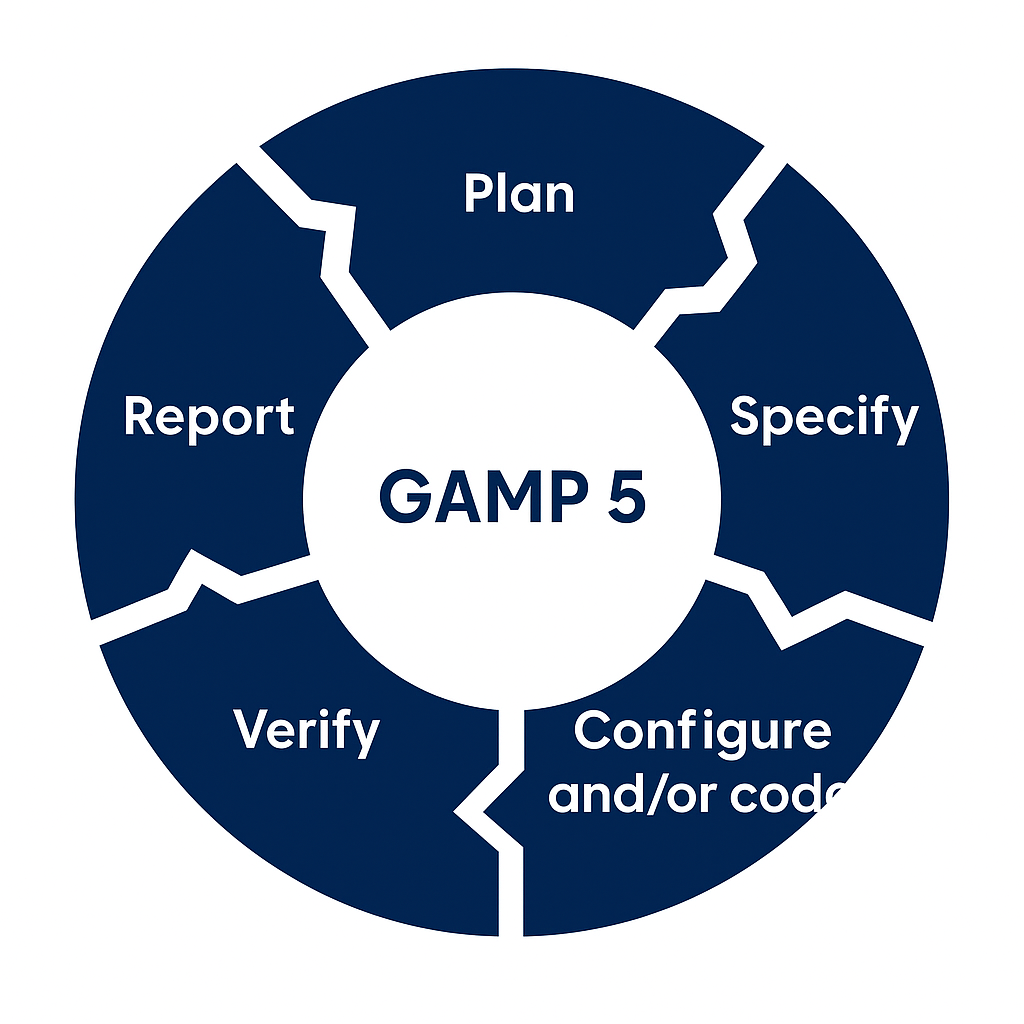
GAMP 5, or Good Automated Manufacturing Practice version 5, serves as a widely adopted guideline for validating computerized systems in regulated industries. Although not a legally binding regulation, it is considered a de facto industry standard and is acknowledged by key regulatory bodies like the FDA and EMA. The guidance promotes a practical, risk-based approach to system validation, encouraging organizations to focus their efforts where they matter most—on ensuring patient safety, maintaining product quality, and protecting the integrity of critical data. By aligning validation activities with actual business and compliance risks, GAMP 5 helps streamline processes while maintaining high standards of control and assurance.
Key Principles of GAMP 5
- Product and Process Understanding
Validation begins with understanding how the system supports business and quality-critical functions. This helps identify potential risks and determine where controls are needed. - Lifecycle Approach
GAMP 5 encourages validation across the entire system lifecycle—from concept to retirement—not just at deployment. - Scalable Lifecycle Activities
Tailor your approach based on system complexity and risk. A simple spreadsheet doesn’t need the same rigor as a complex MES (Manufacturing Execution System). - Science-Based Quality Risk Management
Use formal risk assessments (e.g., FMEA, HACCP) to justify testing and documentation. Avoid a checklist mentality. - Leveraging Supplier Activities
If your vendor has robust quality processes, leverage their documentation and testing, reducing duplication and cost.
GAMP 5 Software Categories:
Category 1 – Infrastructure Software
-
Description: Basic operating systems and system-level software that support applications.
-
Examples: Windows, Linux, Oracle Database, web servers.
-
Validation Focus: Ensure proper installation and configuration. Typically validated through vendor documentation and installation qualification (IQ).
Category 3 – Non-configurable Commercial Off-The-Shelf Software (COTS)
-
Description: Standard software that requires no configuration to operate.
-
Examples: Spreadsheet programs, statistical analysis tools, document viewers.
-
Validation Focus: Verify correct installation and intended use. Limited testing needed unless macros or scripts are added.
Category 4 – Configured Software
-
Description: Off-the-shelf software that requires user-specific configuration to meet business needs.
-
Examples: Laboratory Information Management Systems (LIMS), ERP systems with custom configurations.
-
Validation Focus: Focus on configuration settings, system functions that impact compliance, and verification of those custom configurations.
Category 5 – Custom (Bespoke) Software
-
Description: Fully customized software developed specifically for a particular user or process.
-
Examples: In-house developed manufacturing control systems or custom web applications.
-
Validation Focus: Full lifecycle validation is required—including requirements, design, development, testing, and maintenance—due to the high risk and complexity.
Note: There is no longer a formal Category 2 in GAMP 5—it was removed in earlier revisions due to redundancy with infrastructure software.
Why GAMP 5 Matters for Truchemy
For Truchemy, which operates at the intersection of innovation and regulatory precision, GAMP 5 offers several key benefits:
- Risk-Based Validation:
Instead of a one-size-fits-all methodology, GAMP 5 enables Truchemy to focus resources where they matter most—on systems that pose the highest risk to product quality or patient safety. - Supplier Collaboration:
GAMP 5 promotes leveraging vendor documentation and qualifications, which streamlines internal efforts and fosters strategic alliances with technology providers. - Operational Efficiency:
By aligning validation with system complexity and criticality, Truchemy reduces validation overhead while maintaining uncompromised quality standards. - Audit Readiness:
With GAMP 5’s structured lifecycle approach, Truchemy’s systems and records are always inspection-ready, meeting FDA, EMA, and other global compliance expectations.
The Truchemy Approach to GAMP 5 Validation
At Truchemy, we view validation not as a checkbox activity but as a continuous quality lifecycle. Here’s a glimpse into how we integrate GAMP 5 into our system implementation and maintenance:
1. Categorizing Systems by Risk and Complexity
We apply GAMP 5’s software category definitions—from Category 1 (infrastructure software) to Category 5 (bespoke applications)—to determine the validation approach. For example, a custom-built clinical trial management system (CTMS) warrants deeper validation than a commercially available document management tool.
2. User Requirements Specification (URS)
Truchemy’s cross-functional teams (QA, IT, business units) collaborate to define and document precise URS, forming the cornerstone for all subsequent validation activities.
3. Leveraging Supplier Documentation
Whenever possible, we adopt and verify vendor-provided documentation, such as functional specifications, test scripts, and installation qualifications (IQ), ensuring efficiency without compromising validation rigor.
4. Traceability Matrix
A cornerstone of our GAMP 5 strategy is the traceability matrix, which links URS, functional specifications, test scripts, and final verification—ensuring transparency and auditability throughout the system lifecycle.
5. Ongoing Monitoring and Change Control
Post-implementation, our systems undergo continuous performance monitoring and are governed by a robust change control process. GAMP 5’s lifecycle approach ensures every change is assessed for its impact on validated state and managed accordingly.
Lessons from the Field: Practical Tips from Truchemy
-
Start with Risk: Don’t validate everything equally. Focus on patient and product impact.
-
Engage Early: Bring QA and end-users into the project early to align expectations and responsibilities.
-
Automate Testing: Where appropriate, use automated tools to execute and document test cases, improving repeatability and reducing human error.
-
Train Continuously: System users and maintainers must be trained not just in operation but also in the principles of validation and compliance
Conclusion
GAMP 5 is not just about ticking validation boxes—it’s about embedding quality into every stage of your computerized system’s lifecycle. By applying its principles wisely, pharmaceutical companies can reduce compliance burden, improve efficiency, and most importantly, uphold trust in the medicines they bring to market.