
Beyond Compliance: Why Computer System Validation (CSV) is Essential in Modern Pharma
In today’s pharmaceutical landscape, technology is the backbone of innovation, efficiency, and regulatory compliance. As companies increasingly adopt digital systems for clinical trials, manufacturing, laboratory testing, and supply chain management, the need for Computer System Validation (CSV) has never been more critical. But CSV is not just about ticking regulatory boxes—done right, it’s a powerful enabler of quality, data integrity, and operational excellence.
What is Computer System Validation (CSV)
CSV is a documented process that ensures computerized systems used in GxP environments (Good Laboratory, Clinical, and Manufacturing Practices) perform consistently, accurately, and reliably, according to their intended purpose.
The primary goals of CSV are to:
-
Ensure data integrity
-
Protect patient safety
-
Maintain product quality
-
Comply with global regulatory requirements such as FDA 21 CFR Part 11, EU Annex 11, and ICH guidelines
CSV applies to a wide range of systems, including:
-
Laboratory Information Management Systems (LIMS)
-
Manufacturing Execution Systems (MES)
-
Quality Management Systems (QMS)
-
Clinical Trial Management Systems (CTMS)
-
ERP systems and more
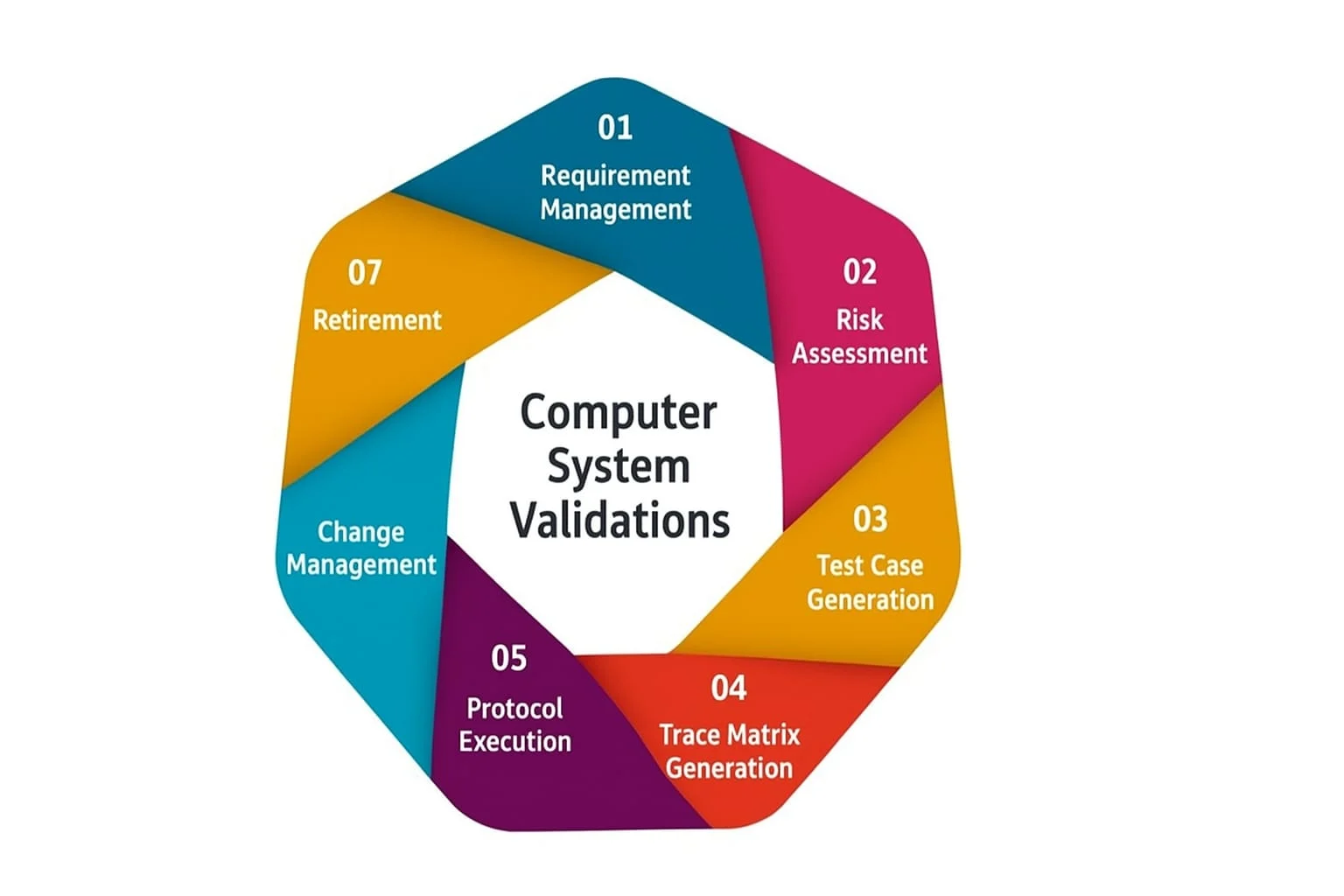
The CSV Lifecycle: A Strategic Approach
A well-structured CSV process follows a lifecycle approach from planning through retirement. Here’s how pharmaceutical companies should approach CSV:
-
Validation Planning
Define the scope, roles, responsibilities, and strategy. Key deliverables include the Validation Master Plan (VMP) and individual Validation Plans (VP) for each system.
-
User Requirements Specification (URS)
Clearly define what the system must do. These requirements are critical because all validation efforts trace back to the URS.
-
Risk Assessment
Apply Quality Risk Management (QRM) to determine which functions or data pose the highest risk to product quality or patient safety. Focus validation efforts accordingly.
-
System Testing
Conduct Installation Qualification (IQ), Operational Qualification (OQ), and Performance Qualification (PQ). Testing ensures the system meets specifications under real-world conditions.
-
Traceability Matrix
Document that each requirement has been tested and verified. This matrix ensures complete coverage and audit readiness.
-
Change Control and Revalidation
Once live, systems must be maintained under change control. Any update, patch, or configuration change must be evaluated for impact on validation status.
-
System Retirement
Even decommissioned systems must be properly retired to ensure data is preserved and regulatory obligations are met.
Why CSV Matters for Pharma
In a regulated industry like pharma, data isn’t just valuable—it’s evidence. CSV ensures that the data generated, stored, and processed by computerized systems is trustworthy and compliant.
Here’s why CSV is vital in the pharmaceutical domain:
1. Regulatory Compliance
Agencies like the FDA and EMA expect validated systems. Failure to comply can lead to severe penalties, product recalls, or loss of public trust. Validation serves as a documented proof that systems meet regulatory expectations.
2. Data Integrity
CSV reinforces data accuracy, consistency, and completeness across the data lifecycle. It supports ALCOA+ principles (Attributable, Legible, Contemporaneous, Original, Accurate, plus Complete, Consistent, Enduring, and Available).
3. Risk Mitigation
Proper validation helps identify potential system failures or data handling errors before they impact patient safety or product quality. This proactive approach minimizes business and regulatory risks.
4. Operational Efficiency
Validated systems operate with fewer disruptions, better reliability, and faster audit readiness. CSV helps standardize system use and reduces time spent troubleshooting or revalidating under pressure.
CSV at Truchemy: Our Approach
At Truchemy, we take a risk-based, lifecycle approach to CSV, aligning closely with the GAMP 5 (Good Automated Manufacturing Practice) guidelines. Here’s how we integrate CSV into our operations:
1. Risk Assessment and Planning
Before any system implementation, our validation team performs a detailed risk analysis. This helps us prioritize validation efforts based on system criticality, data impact, and regulatory exposure.
2. Vendor Qualification
We partner with vendors that understand the stringent regulatory requirements of the pharma industry. We assess not only product features but also their quality systems and validation documentation.
3. Validation Lifecycle Execution
From User Requirement Specifications (URS) to Operational Qualification (OQ) and Performance Qualification (PQ), our validation lifecycle ensures full traceability. Automated test scripts, audit trails, and deviation tracking are baked into the process.
4. Change Control and Revalidation
Systems evolve. At Truchemy, any change—be it a patch, upgrade, or configuration update—undergoes impact assessment and, if necessary, revalidation to maintain the integrity of our data and operations.
5. Documentation and Audit Readiness
All validation activities are thoroughly documented, version-controlled, and stored in compliance with 21 CFR Part 11. This ensures we’re always audit-ready.
Common CSV Pitfalls—and How Truchemy Avoids Them
While many companies struggle with over-validation, under-validation, or documentation lapses, Truchemy avoids these pitfalls through:
-
Automated validation tools that reduce human error and increase testing coverage.
-
Cross-functional collaboration between IT, Quality Assurance, and business units to ensure requirements are realistic and comprehensive.
-
Continuous training and improvement, ensuring all stakeholders are aligned with evolving regulatory expectations.
Future of CSV: From Validation to Assurance
As the pharmaceutical industry adopts cloud platforms, AI tools, and Software-as-a-Service (SaaS) solutions, the traditional CSV model is evolving. Regulatory agencies are now encouraging Computer Software Assurance (CSA)—a modern, risk-based, less documentation-heavy approach that emphasizes critical thinking and system performance.
Key differences:
-
CSV focuses on documentation.
-
CSA focuses on critical thinking, risk, and system behavior.
Forward-thinking companies are already piloting CSA frameworks to accelerate validation and reduce compliance burdens without sacrificing quality.
Final Thoughts
As pharmaceutical companies continue to digitize operations, robust CSV processes are more critical than ever. Investing in proper validation not only ensures compliance but builds trust with regulators, partners, and patients.
By treating CSV as a strategic asset rather than a compliance checkbox, organizations can unlock greater innovation, efficiency, and assurance in delivering safe, effective medicines to market.